

What to Consider When Buying a Furniture Set?

Choosing a furniture set isn’t like picking up a throw pillow on impulse. These are the pieces that frame your mornings, hold your deadlines, store your clutter, and quietly shape how your home feels every single day.
A well-chosen furniture set doesn’t simply match in color. It functions as a system—structurally consistent, visually aligned, and proportionally calibrated to work together.
When pieces are designed as a collection, their scale, material transitions, and construction philosophy reinforce each other. That systemic coherence is what separates a composed room from a room that merely contains furniture.
Before committing to a full set—whether for a living room, bedroom, or home office—these are the fundamentals that matter most:
1. Structural integrity
2. Material quality
3. Functional ergonomics
4. Spatial compatibility
5. Lifestyle alignment
6. Long-term adaptability
Skip any one of these, and the set may look impressive on installation day—but begin to disappoint within a few years.

How Important Is Structural Construction?
Foundation always comes first.
When purchasing a furniture set, structural consistency becomes even more critical. If one piece is solid hardwood and another relies on low-grade engineered panels, wear patterns will diverge over time. A coordinated set should age cohesively—not unevenly.
A beautiful exterior cannot compensate for weak joinery, unstable support systems, or low-density internal cores.
Frame & Construction Comparison
| Construction Type | Durability | Best For | Watch Out For |
|---|---|---|---|
| Solid hardwood | 15+ years | Daily heavy use | Higher price |
| Plywood (multi-layered) | 10–15 years | Mid-range furniture | Thin low-grade sheets |
| Engineered wood | 5–10 years | Budget spaces | Moisture sensitivity |
| Metal frame | 10–20 years | Modern styles | Weld quality |
For storage pieces within a set—dressers, sideboards, cabinets—inspect:
● Dovetail or reinforced drawer joints
● Soft-close hardware
● Back panel thickness (thin backing signals cost-cutting)
For tables and desks:
● Leg attachment method
● Crossbars or internal structural support
● Weight-bearing capacity
If a piece wobbles in the showroom, it will not stabilize with time.
Featured Product:
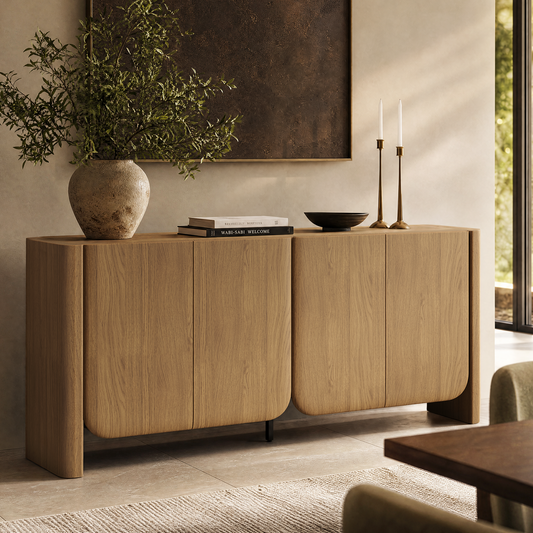
> Naya 2-Door Storage Wood Sideboard

What Role Do Materials and Finishes Play?
Materials determine how your furniture set matures. In a coordinated collection, finishes should not only look harmonious—but also wear harmoniously.
If the dining table surface scratches easily while the accompanying sideboard remains pristine, visual imbalance develops. Cohesion isn’t only about color—it’s about aging at the same pace.
● Heat resistance
● UV stability (especially near windows)
Upholstery & Surface Materials
| Material | Durability | Maintenance | Reality |
|---|---|---|---|
| Leather | 100k+ rubs | Condition quarterly | Develops patina |
| Performance fabric | 50k–100k | Blot spills | Made for living |
| Linen | 15k–25k | Professional clean | Higher upkeep |
| Veneer | Long-lasting | Avoid moisture | Stable if sealed |
| Laminate | Moderate | Easy wipe | Practical |
| Stone | Extremely durable | Seal if natural | Statement weight |

How Do Dimensions Shape the Room?
Furniture sets are often purchased for convenience, but scale misalignment is one of the most common mistakes. Even within a coordinated collection, the proportions must correspond to your actual square footage.
Spatial planning is less about decoration and more about circulation logic. A room feels calm when movement paths are clear and visual weight is distributed intentionally.
Spatial Planning Essentials
● Measure doorways, staircases, and elevators before ordering
● Leave 12–18 inches between seating and coffee tables
● Allow 36–48 inches for primary walkways
● Maintain proportional balance (large sectional + undersized rug creates visual instability)
● Consider ceiling height when selecting tall cabinets or shelving
General Configuration Guidelines
| Room Size | Approach | Why |
|---|---|---|
| Small apartment | Compact modular pieces | Maximize space |
| Medium room | Sofa + console + coffee table | Balanced layout |
| Large open plan | Sectional + anchor cabinet | Define zones |

Featured Product:
> Nolan Extra-Thick 6-Drawer Dresser
> Nolan Charging Media Console
How Do Lifestyle Factors Influence Your Choice?
Furniture should reflect lived reality—not aspirational minimalism.
When selecting a full set, consider how each piece interacts with daily behavior. A stain-resistant sofa paired with a delicate coffee table creates functional contradiction. A durable dining table paired with fragile upholstered chairs introduces imbalance.
Lifestyle Alignment Matrix
| Your Reality | Prioritize | Avoid |
|---|---|---|
| Pets | Tight weaves, leather | Delicate fabrics |
| Young children | Rounded edges | Glass-heavy pieces |
| Remote work | Ergonomic support | Decorative-only desks |
| Frequent hosting | Expandable tables | Fixed small tables |
What About Ergonomics and Comfort?
Furniture sets are often evaluated visually, but comfort determines longevity.
A desk two inches too high strains shoulders.
A dining chair without lumbar support shortens dinner conversations.
A sofa that appears elegant but lacks proper seat depth becomes underused.
● Seat height (16–18 inches typical)
● Desk height (28–30 inches standard)
● Backrest angle
● Armrest support
How Does Longevity Align With Your Design Philosophy?
Trends rotate quickly; structural foundations remain.
In a furniture set, anchor pieces—sofa, bed frame, dining table, desk—benefit from restrained silhouettes and neutral finishes. Accent elements can evolve over time without destabilizing the room’s structure.
Ask yourself:
● Will I still appreciate this silhouette in five years?
● Can this set adapt if I relocate?
● Are the finishes forgiving to daily wear?
A well-selected furniture set supports transitions—from first apartment to long-term home—without demanding replacement at every life stage.
Featured Product:
> Nolan Extra-Thick 6-Drawer Dresser

Inspect hidden joints. Confirm materials. Measure twice.
The right furniture set does more than fill a room. It establishes proportion, absorbs everyday pressure, and maintains structural clarity through years of use.
Choose accordingly.
See the Set




![[Pre-Sale] Harmo Block 70" Tall Arched Bookcase with Doors](
//www.modernmate.net/cdn/shop/files/Harmo_Block_Arched_Bookcase_Media_2.png?v=1781338446&width=533
)


